Wednesday, October 13, 2010

Oct 8: Luxor

Aswan to Luxor


Up the Nile! On a three-hour train ride where we bought tickets on the train. It wasn't full, so we hopped on and bought "standing" tickets for the ride, which were half the price of normal tickets. Still, we got seats. (Remember this for later.)

Upon arriving in Luxor, we cabbed to our hotel. If you're ever in Luxor...STAY HERE.


It's called the Bob Marley Hotel...12 LE per night, a rooftop lounge, and Bob Marley everywhere. The guy at the desk got us a nice deal on a driver around Luxor for the next day, and also promised to get us tickets for the ride back to Cairo while we were out sightseeing. (Also remember this for later.)

The next day we were up early to do a blitz of as many Luxor temples as possible. After stocking up on fool and falafel at a street place, our driver took us to destination 1:

The Valley of the Kings


Many of ancient Egypt's pharaohs, mostly from the New Kingdom period, are buried here. They decided to move their burial sites to the valley after all the embarrassing robberies of bodies and treasure from the somewhat less-subtle Pyramids at Giza and Saqqara. Valleys are much easier to defend from tomb robbers, right?

Wrong. The tombs still ended up being robbed. In some cases robberies even happened soon after the king was buried there. This is because unlike the policies of other ancient civilizations in China or Mexico, the Egyptians didn't kill the architects and builders of their tombs after the tombs were finished. Basically a hopeful tomb robber would go up to one of these people (could also be a guard, or anyone who has some knowledge of the layout of the tomb and its potential entrances), and he'd offer to give the guy a cut of his "earnings" if he helps him out with getting in. This happened disturbingly often, and it's why we have so few incomplete tombs nowadays.
Anyway, the authorities can fine you an obscene amount of money if you get caught taking pictures inside the tombs, so be content with the above Google map. The humidity in the first tomb we entered, about 100 feet underground, was like DC but in the Jurassic Period. So much that when we emerged into the 105-degree sunlight it actually felt cool.

After Valley of the Kings, it was time for Hatshepsut's temple.


Onward to Medinet Habu, one of my personal favorites.


To verify their enemy casualties, the Egyptian soldiers would bring back wagonloads of heads or...well, you can figure it out from the picture, given the Egyptian obsession with humiliating the enemy in most painful way.


...yeah, it's a battle. Remember this for later.

We wanted lunch, so our driver tried to figure out where we should best go. He first stopped at a hilariously overpriced place in downtown Luxor where he was friends with the manager. We left rather quickly and tried the place across the street, which didn't look open since it was Friday. The broken English the guy spoke there seemed to mean that we could sit down and have lunch, but the fact that they literally had no other customers and would have to make us food special seemed somewhat sketchy. We exited, and the owner followed us, offering to take us to another place that was open. He stopped at a European-style restaurant with a minimum charge of 100 LE per person. Not another one! Luckily, our driver had been looking for us after he noticed we weren't in the second place anymore, and he drove up just as we were about to go inside and get ripped off yet again. This daring rescue earned him major points. We told him we'd just get koshary, but he seemed to really want us to spend some serious money since the next place he took us was to a buffet restaurant full of European tourists. Probably the same ones who were willing to buy a can of beer for 13 Euros at Abu Simbel. Knowing this was not good, I subtracted his points and told him to take us to koshary NOW.

Good old Egyptian food. Not great, but not pricey, either. Final stop: Karnak, the largest temple in Egypt. It's the big brown square north of downtown Luxor on the map below, so you can get some idea of its size.


Tuesday, October 12, 2010

Aswan to Abu Simbel to Luxor


Looks cool, right?
Ramesses II is one of the most well-known Pharaohs of ancient Egypt, known for going on a building spree of temples and gigantic monuments, and for possibly being the Pharaoh of the Exodus as the primary antagonist in the story of the Israelites' freedom from slavery.
As the pictures show, Abu Simbel was no exception. In fact, Ramesses built this massive statue of him (times 4) to give a clear message to the peoples of the South: "Don't you dare fight Egypt because I'm so great and powerful, I can build these massive monuments and destroy you just as massively." But in addition to the warning/intimidation aspect of Abu Simbel, it was also used as a temple.


Take a quick look at the map above. Lake Nasser takes up most of where the Nile should be in southern Egypt and northern Sudan.
That's not a natural lake. It was formed in the 1960s, as President Nasser's pride and joy, the Aswan High Dam, was being built. The dam would provide as much as 25% of all of Egypt's energy in the form of hydroelectricity as well as stop the Nile's disastrous seasonal floods that had plagued Egyptians for thousands of years.


As with anything, though, there are upsides and downsides. While the Nile had repeatedly flooded its banks every year, farmers depended on its deposits of fertile black soil (silt) that would wash over their lands and bring them a good crop yield.
With the construction of the Dam, the Nile no longer flooded, there was no more silt...and Egypt began to have a food crisis that it still suffers from today. Today, the only good place to fish is near the Mediterranean Sea.

(The pollution in the Nile has gotten so bad that, when asked whether it would be safer to have oil tankers dock by the Red Sea instead of in the Nile following an oil spill in Aswan, a marine biology professor at AUC replied to the effect that the Nile is the more polluted of the two bodies of water, and nothing lives in it anyway, so there's no problem.)

With the formation of the massive Lake Nasser, hundreds of archaeological sites south of the dam were in danger of becoming completely submerged underwater. Although the flooding process had already begun with a the construction of the smaller and less effective Aswan Dam in 1902, the new dam's lake now threatened to engulf these monuments completely.

So UNESCO stepped in and told Egypt that it needed to save these monuments. From what people have told me, the Egyptians weren't convinced, being more concerned with the welfare of their own people than a bunch of ancient temples. Which is, in a way, understandable. But then UNESCO told them that they could make loads of money off of tourism from these sites...and voila! Egypt approved their request to mount a massive rescue effort.


It took over ten years, but with a combination of ingenuity, artistic and engineering skills, UNESCO and many nations worked together to move what they could to higher ground. These efforts included cutting up thousands of hundred-ton pieces of stone from the temples and painstakingly lifting them to a reassembly site, where they were put back together and set in their new places.

Without their efforts, Abu Simbel would lie about 200 feet lower today, at the bottom of the lake and only accessible (perhaps) by scuba diving. Seen here in the model at the Nubia Museum showing the submerged temple's former area (bottom of photo) and where they moved it to up the cliff.


Same thing for the temples on the island of Philae (now underwater, visible in the satellite photo as a small shadow-like oval in the lower right corner to the right of the larger island). They were moved to nearby Agilika Island, where workers had to level the island using dynamite to recreate a near-perfect landscape mirroring the layout at Philae. All the temples you see in these pictures are in identical positions relative to each other and the Sun. This is important because every year on February 22 and October 22, the Sun shines through to the back of Abu Simbel and illuminates exactly three of the four seated statues...something the ancient Egyptians originally planned quite well.


View from Aswan High Dam


Major props to all these conservationists!

Tomorrow, I'll divest so you can learn about ancient Egypt's political and religious system. I promise it won't be boring, and it'll help you understand Luxor's temples and tombs.

Sunday, October 10, 2010

Oct 6: Cairo to Aswan


Oct 5: Egyptian Museum
Today my Egyptology professor, Salima Ikram, took us around the Egyptian Museum for the first time. Highlights included a disturbing stone mask from the predynastic period and below-the-waist statue of Min, the fertility god, with pillar-sized legs and baseball-sized...yeah. Anything above that was removed awhile ago and is now elsewhere, but I've heard it was the length of a ruler and gilded.

Got on the train to Aswan at 10. Ihsaan and I sat with some Australians, one white guy who was married to an Asian-Australian, and her brother. A train worker came into our car asking if we wanted dinner, saw these foreigners, and said, "Ah, you from Japan!" (They were ethnically Chinese but of course it's the same thing here.)


We endured a 14-hour freezing-cold train ride (see above) to Aswan, which is close to the Sudanese border. Upon arriving in Aswan around 12pm the next day, we left the station and were immediately solicited by at least ten felucca captains who wanted us to take a ride with them. Their prices were ridiculous. It's hard when you want to see if you can get a good price but at the same time don't want to seem too interested, because then they will NOT stop following you. One guy followed us almost to our hotel about a half mile away, telling us he was giving us a good price (not really) and that we had to go with him now.


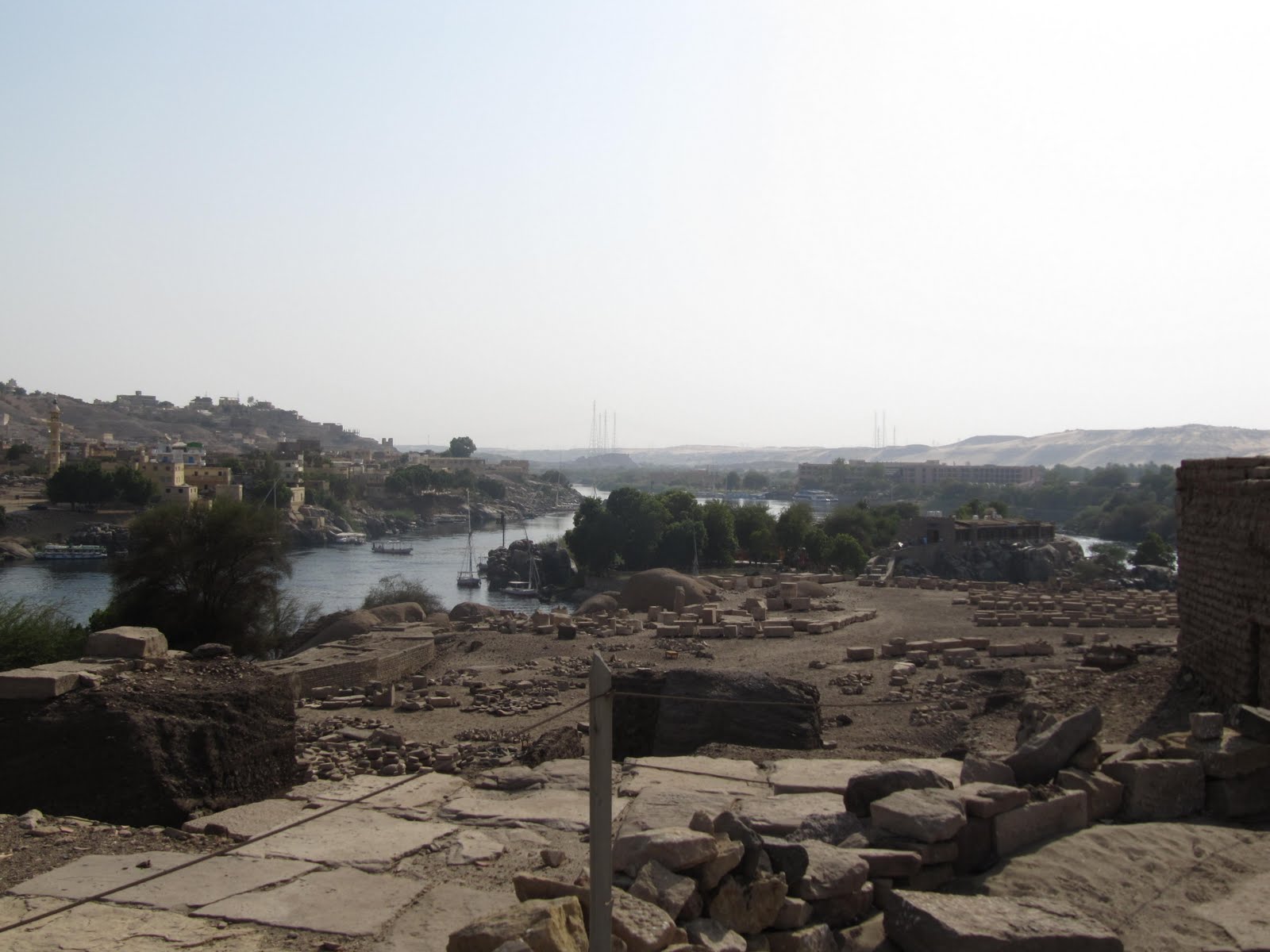
After checking into our hotel we put our stuff down and went out to explore, taking a 2-minute felucca ride to Elephantine Island. There were some cool artifacts there including a 3-D model of the island's temples and some cool inscriptions.


Major props if you can tell me what this script is. It looks almost like a cross between Hebrew script, Hindi, Phoenician and Greek. My guess is Hieratic?


We went over to the Temple of Isis after walking through a nice garden on the other side of the museum...it's a huge complex which has artifacts from the Greek and Roman periods, as well as earlier times where Elephantine housed a community of Jewish mercenaries hired by the Egyptians to fight the Nubians in the south.


Once we had had our fill of monuments, we trudged south to go to Sehel Island, home of the famous Famine Stela carved by King Djoser to commemorate his prayers to the god Khnum to stop a terrible famine. We didn't make it to Sehel because the felucca guy wanted to charge 120 LE for everyone, so we opted for the Nubian Museum instead.

We had to present our IDs at the ticket counter. When the man saw my last name, he asked if I was Jewish. Tired of lying, I said yes, but not Israeli. He asked me aren't they the same thing. I told him no, of course not. Not wanting to get into an intense discussion (all this was in Egyptian Arabic), I promised I'd talk to him later when we left the museum.
The Nubian Museum itself was unlike any museum I'd seen so far in Egypt--well-lit, clearly labeled artifacts, nice displays...


Who were the Nubians? You actually probably know at least one: the late Egyptian President Anwar al-Sadat.
In ancient times before today's borders were drawn, the Nubians were Egypt's perennial friends and enemies in the South, historically occupying what is now northern Sudan and extreme southern Egypt, past Aswan. For ancient Egypt, Aswan was the last defense outpost before reaching Nubia. Depending on the period of time, Egypt either had complete control over the Nubians and ruthlessly extracted their raw materials for use in their empire, or the two groups were somewhat friendly.


In a dramatic reversal of fortune in 760 BCE, the Nubians took over parts of southern Egypt when a dispute between dynasties in the Delta led Egypt to become rocked by instability. The Nubians eventually took over all of Egypt for a period of about 100 years, fighting off repeated Assyrian invasions from the Near East until they were finally defeated and pushed back to Nubia. Ironically, during this period they tried to "restore" ancient Egyptian traditions and artistic/architectural styles, probably so they could claim legitimacy as the inheritors of the Pharaohs' dynasties. There was a lot of cultural exchange between the two powers; you can see the influence the Egyptians had on Nubia by these pyramid-like tombs, located in northern Sudan at Meroe.


On the way out I had that 30-minute Arabic discussion with the ticket guy about Jews and Israel. I'd like to say I enlightened him, but after all we'd said, he just suggested I read the Qur'an so I could become enlightened. Sigh.

Abu Simbel bright and early tomorrow. Leaving at 2:45 AM!

Saturday, October 9, 2010

Standing up for yourself (or not)

On any trip, fatigue will invariably set in, no matter how excited you are to be away from home. In this case, it was on a 12-hour train ride from Luxor to Cairo sitting in between cars, without seats, in the small doorway areas Egyptians frequently enter to smoke a pack of cigarettes. Cigarette smoke is bad enough outside, but in a train car where there's no way to escape, it's impossible to breathe.

Couple that with extremely cold compartments, Egyptians who will not stop jabbering away in 3ameya until 5 AM, and a man carrying a computer CPU who's trying to get secret photos of your friends (girls) with his phone camera...and you've got yourself one hell of a ride.

That said, what could at best be called a "cultural experience" was at an all-time high, as we learned what it truly means to get a "standing ticket."

Not to worry, Luxor and Aswan made up for all this. Pictures soon.

Thursday, September 30, 2010

Culture Conglomeration and Political Correctness

What happens when a white guy attends an South Asian culture festival in the middle of an Arab city and tells a suited delegate "Masaa al-kheir, aap kaise hai?"

A: A very confused Indian ambassador

Last week I attended the opening ceremony of Indian Culture Week, organized by the Indian Embassy and the Maulana Azad Center for Indian Culture. Coming from a multicultural American perspective, it astounded me to see Indian Egyptians in the audience. There is diversity in Egypt, I guess I just didn't see it as obviously as in America.


Another thing: In Egypt, there doesn't seem to be such thing as political correctness. For example, my Arabic teacher freely admitted to disliking Japanese people "because they don't say anything in class." But he did say they were very well-organized and motivated, so I don't really know what to think.
As for Indians, when we were walking through a bazaar one of the shopkeepers saw my friend Ihsaan and asked, "Tikka tikka accha accha?" mumbling something about 7-Eleven that we didn't figure out until we'd walked away. (For those of you who didn't get that, it's like saying "Mazal Tov bagel I-just-dropped-a-penny" to a Jew or "Watermelon Basketball" to an African-American.)

At the risk of offending even more people than I already just did, I'll assume you understand when I say that stereotypes here are not only appropriate; they're a means of entertainment. That said, stereotypes here can be both good and bad. The difference is that it's not considered offensive among many Egyptians to talk about other races and cultures in a value-judgment way--partly, I think, because they make fun of themselves so much already.

Many things we'd take extremely seriously in America are laughed off here. I've heard about drivers who get in accidents around Cairo and get out of their cars, yelling at each other about how stupid the other was, when one cracks a joke, defusing the situation and allowing them to go their separate ways.

Anyway, all this just goes to show you that there's much more to Egypt (and any other culture for that matter) than initially meets the eye. Here, an Egyptian ministry official speaks about the importance of cultural relations.


We met the Indian Ambassador, which I realize is not too special since there's two for every pair of countries (India-Egypt, Egypt-India, US-Kazakhstan, Kazakhstan-US, etc), but it still was a thrill to get so close to the levers of power. Not too close though, since his chauffeur almost backed into us as we were standing in the street in his designated parking space.

In yet another paradox, last Thursday I found myself at the Opera House once again, watching a film in Hindi/Punjabi with Arabic subtitles, while my Indian friend translated the Hindi for me as I combined my little understanding of this and the Arabic subtitles to tell my three Egyptian friends what was going on, (because they couldn't understand the standard, formalized Arabic too well). To complete the night, we ate at Nawab, easily one of the best (and least expensive) Indian restaurants in Egypt. I couldn't decide whether Shukran or Shukria was the best response to the manager telling us where to sit, so I settled on Shukrian.

Finally, the closing ceremony last night featured a 40-minute dance recounting the story of Krishna, a Raas team from the state of Gujarat, and a contemporary fusion band called Talaash made up of two guitarists, a drummer and a maraccist. No, not racist. Maraccist.

...and that's The Word, Stephen.

Sunday, September 26, 2010

Bad dates

The hot sun beat down on the vast landscape of dunes. Jumping out of the bus, we scrambled up a hill and through a shallow valley, passing colossal inscribed stone blocks scattered across the sands. The valley opened, and we beheld the remains of one of Egypt's forgotten cities.


We had arrived at Tanis, fabled resting place of the Ark of the Covenant. Tanis, known as Djanet to the ancients before the Greeks arrived and corrupted everything, sits on a large hill made of ancient cities built on top of each other (called a Tell), across from the modern Arab city of San el-Hagar in the northern Delta region. In ancient times, Tanis became a flourishing port city after the Nile changed its course and the Egyptians had to move their former riverside capital, Pi-Ramesses, elsewhere. It's desert today, since the Nile moved yet again. The demands of this epic move meant that due to the scarcity of stone building materials for temples and tombs, they had to dismantle the temples in their city and move the stone to a more hospitable place. A huge project, no doubt, likely involving hundreds of slaves with foreign Near Eastern ancestors...but that's just my guess.


As I carefully plodded through the uneven sands, I wondered if I'd fall through the roof of some undiscovered tomb onto a bed of snakes. I couldn't help but remember Belloq's quote from Raiders of the Lost Ark: "You will now become a permanent addition to this archaeological site. Who knows, in a thousand years maybe even you may be worth something!"

Considering only about 10% of the site has been excavated, I'd say there's a fair chance of finding the Ark here. Maybe it was in this box.


I would've tried to open it, but our police escort and a guard were watching my every move from a hundred feet away, and Egyptian jails suck, to put it lightly.